Tuesday, 18 October 2011

Cranbourne Chase Woodfair

What a joy to go to a well organised woodfair in the south of England. After the Tree Fest at Westonbirt
I realised that shows have not been good for me this year, and sales have been down by a very significant amount. I have had growth year on year for the last 18 years of trading, this year has been a wake up call. I am in the non essential and luxury goods market and people are cutting back, big time.
Dan and I had a great time at the show, always good to met up with people again, and make new friends. We met a few people who we know from the Bodgers forum, and it is always good to put a face to the name. It was good on Saturday night, talking to Kim and Tim of Former Glory and then being joined by Owen Jones and Jeremy Atkinson, and then Neil Taylor who bought me that last fatal drink.

This Woodfair runs competitions. Four prizes for 4 categories. This year I won the Peoples Choice. This is by public vote and the people chose me and my hummingbird supping nectar from a wooden flower. The prize was a beautiful box by Mathew Burt who judged the three other categories.

It is fantastic to be voted best in show, but during these hard economic times I do need to find new ways of selling my work, especially finding out more about advertising and marketing. If anyone has any ideas please contact me.
 Rod Poynting`s oak gate topped with copper caps.
Will Witham`s whale and fish puzzle. I have known Will for many years and he only lives a few miles away. He works mainly on the fretsaw.
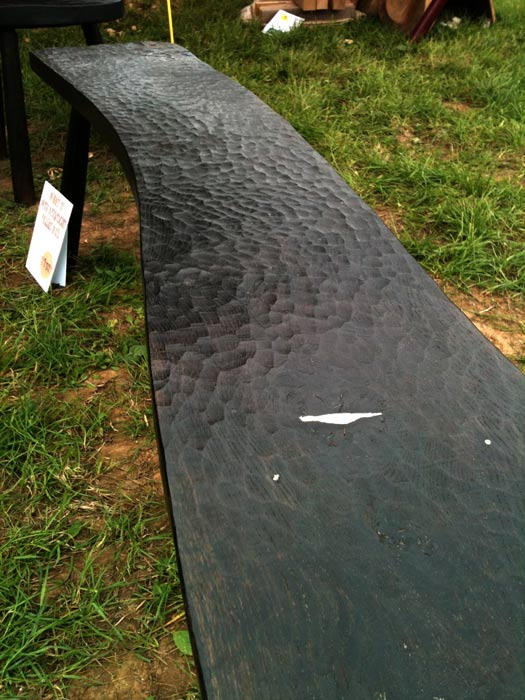
Neil Taylors table/bench, pickled with vinegar and iron to blacken it. Neil has worked with Gudren Luitz and Mike Abbot. The tooled finish is stunning.


Wednesday, 5 October 2011

Dan`s drawknife

Dan has been telling me all about the drawknife he has been making in his spare evenings. But when I saw it I was gobsmacked! It was indeed impressive. To pile on the admiration for Dan, I was even more surprised when he said he made it in the 2-brick kiln he made in my forge and tool making workshop that I ran last year.
 It just happened by chance that I wrote about how to handle a draw-knife just after Dan showed me his un-tempered knife.


I gave the drawknife a go and it works like a dream. Dan learnt a lot from the process and will change a few things next time. The tangs are a bit big at the curve and the handles are to big for my liking. Small things really, that will get changed next time, but this is how we learn. I am so impressed, what an amazing first drawknife.
This is the 2-brick forge that Dan made in my workshop.

Some of the tools made on the workshop. I think this years workshop in Oct is full, but you can always come and do a 1 or 2 day one-to-one workshop with me.

Thursday, 29 September 2011

How to handle a drawknife and other tanged tools

To follow on from the post on how I sharpen drawknivies. Here is how to put new handles on it. I will assume that either you have handles, or can turn new handles, either on a pole lathe or a modern electric lathe. If turning on a pole lathe either turn green, dry the handles, and then turn again when dry to fit the ferules, or turn from seasoned wood. I often turn dry wood on the pole lathe if I want round turnings. If possible use the original ferules or use new ones or cut some from brass or copper pipe. The ferules will need to be put onto seasoned wood, we do not want the wood to shrink and the ferules to become loose. This is a C Whitehouse drawknife, and I turned the the handles to the same pattern as the originals.
I use long series drill bits and I drill in from each end rather than drilling all the way through. This way you will get the entry and exit holes in the right place. This process is not easy, so practise on odd bits of wood to hone your technique.
If necessary drill a larger hole part way through if the the tang is thick at the blade end. The old handles are split off using an old chisel.
I am lucky that the tangs are in reasonable condition. This one had a bit of rust and is slightly thin in the middle, but will work well enough. Sometimes you will need a new tang welded on. Unless you can do this yourself, find a friendly blacksmith or fabricator to do this for you.
 Make the tang straight by heating it with a blow torch. Make sure that the blade section does not get to hot as making the blade too hot can change the temper or hardness of the steel. Note that I have the blade on my anvil, which acts as a heat sink for the blade.
Make each tang straight and in line with each other.
Heat the tang up again and push the handle onto the red hot tang.

Do not push the handle all the way onto the tang, leave enough so you can hammer the handle firmly onto the tang. Pull the handle off as soon as you have got far enough down the tang. It is best to let the tangs cool down slowly as quenching in water can harden the tang and make it brittle.
When the drawknife is cool to the touch, paint linseed oil onto the tangs and inside the burnt hole. Using a scrap bit of wood with a hole drilled into it, bang the handle fully down into place.
I made a washer from a bit of brass, and if the tang sticks out a bit to far just file or cut the excess off. You only want 2 to 3mm protuding above the washer.
Using a ballpein hammer, mushroom over the tang. Do this hammering the tangs outer edge around in a circle, do not hit the tang square on in the centre.
The finished  handle.
Bevel up
Bevel down
With a wooden mask for the blade.

I use the same general principles for putting handles onto chisels.

Saturday, 24 September 2011

Carved wooden hummingbird.

Sometimes it takes a simple addition to lift an item into being a great artefact. If you read my last post I was happier with the hummingbird drinking nectar from a wooden flower on a thin bent willow stick, which was totally impracticable. The other set up was functional and long lasting, but lacked something. At the workshop I had an idea of putting leaves onto the base of the flower. Needing something that was quick and simple I picked up some ash shavings from the shaving horse and fashioned them into petals.
The whole fanbird and flower is now more balanced.  I have noticed that it so easy to go too far with finishing or embellishment and ruin a piece of work. The" KISS" saying has a lot of truth to it, "keep it simple stupid". I thank my good sense to use waste shavings rather than making or carving wooden petals, which could have made the bird with flower more expensive and time consuming.

Thursday, 22 September 2011

Hummingbird fan bird, with real wooden flower!

Same bird but 2 different flowers and flower stems. I know which I like best, but it is very likely to get broken.
I love the way it moves in a slight breeze. The other issue is that the thin willow stem will droop over time
This one will last and is easier to post and pack.

All fan birds are for sale, I hope to revamp my fan bird page on my web site and also have a few for sale on a sale page on this blog, very soon.