Thursday, 3 February 2011

Quality tools - cheap axe

I love my Gransfor Bruks carving axe, as I love my Whitehouse and Gilpin kentish pattern axes. These are known as top quality tools by anyone in the know, and sometimes they can cost an arm and a leg. Gransfor Bruks has been doing outstanding business for some years now. I have seen people selling the axes at markets to passers by, and at £50 minimum each. That is something I thought that I would never see.

I am a great believer in using and renovating old tools that others throw away, and have written articles for magazines describing the processes involved. If you are starting out on your greenwood or bushcraft journey and can not afford a GB axe, or have not yet learnt the techniques of making, fitting and sharpening old tools then there is another option.

The old adage of buy the most expensive tool you can afford is still generally true, but to make my point about renovtion, I went out and bought the cheapest axe I could find. How much? £3.25 for a "Rolson Quality tools".
 
It was the gold colour that drew me in, a gold coloured axe, cool. Five minutes on the grinder, or you could easily use a file as the metal in axes is quite soft. Then onto the bench stones where I got the original angle of 60+ degrees down to 32 degrees and slightly sided. Siding means that the bevels on each side of the axe are not even, and being right handed, I need the left hand bevel to be longer and flatter and the right needs a more obtuse bevel. This is so I can use the axe in a more upright or vertical position, just what I like for green wood working.
The handle was a nightmare, far to big for my hand. I often hold the axe up near the head for greater control, so out came the knife and I whittled the handle down.


Above is the end result: it is sharp and can slice a sheet of newspaper easily. It worked a treat on green wood. On seasoned fast-grown ash I struck a problem as the edge rolled or bent over slightly, so out came the diamond stone and I resharpened it. The same happened again, cheap axes, I was thinking good for splitting wood only. This time I resharpened again and took the bevel to just over 35 degrees and I have had no problems with it since, and have hacked through a fair bit of wood with it.
I like the shape of the head and the toe is perfect for getting into the wood, especially when doing spoons. I still do not particularly like the handle, and would like to replace it with one I have made. The steel feels just a bit softer than my other named brand axes, but since getting the edge geometry right, this is not much of an issue.
The thing is, that if I sanded the handle smooth and removed all paint etc, blacken the head, and asked you to use it, would you be able to tell this was a cheap £3.25 axe?
This would not be my first choice when selecting an axe to use in my workshop, but then again I do have over 20 to choose from. With a little modification it works and works well. When I first got my GB wildlife axe I still had to grind the edge to the geometry I needed for the work I do.

Tuesday, 18 January 2011

Save our Forests

Our government want to sell all woodland and forest, owned by us all, off to the highest bidder.

Need more info and facts then check out this website, http://saveourwoods.co.uk/


Monday, 17 January 2011

Palm drill

I met Ian Swain at Bentley woodfair this year and had some great chats with him. Ian was selling tools with a colleague. I bought an Elwell 4-pound carpenters axe with Elwell branded into the handle.  I would like to use this axe, but because of it`s more or less unused condition, it is a collectors piece.The original paper label is still glued to the handle and a sticker on the axe head, all in very good condition, and for a very good price. I also bought a Belgium Coticle stone and some other tools.


Anyway - what I was really interested in was the solution to a common problem faced by people who work with young children, that is: drilling holes safely. Young children find it difficult and often impossible to use bit and brace or egg-whisk type drills. So Ian got some file handles and good quality engineers' drill bits and glued both together. Below is a video of how easily it works.

Ian sells these at http://www.theluddite.com/forestschoolequipment.html

Sunday, 26 December 2010

Coracles and Edwardian Farm

Sean making a coracle on Edwardian Farm

I was on Edwardian Farm, episode 8, this Friday 24th Dec making a coracle. For those of you who have not seen it, it is an ongoing documentary about 3 people who live and work on a farm as they would have done in Edwardian times, 1901 to about 1920.

I spent a very enjoyable 6 hours or so with Alex helping him make a coracle, all of which was filmed. During the day's filming I went into great detail about how to make a coracle, but only a brief overview was shown on the TV. If you just want to see the coracle bit, then it starts about 16 mins in, and finishing it off at 20mins, the coracle being used at about 24 mins. I bought the book the other day and there is a small photo of me in it. Being a person who loves to know how things work or get made, Edwardian Farm has been fascinating for me, both Lucy and I love social history. I wish they had the time to go into far more detail both in the book and series, but I know they need to make an engaging and entertaining program. A program that I would love to see would not appeal so much to the normal BBC2 audience.
I do not like watching myself, especially when seeing it for the first time, so I  squirmed, like when I watch Ricky Gervais or Alan Partridge or even Peep show.


http://www.bbc.co.uk/programmes/b00x1tgv
A bit about this episode and a photo of Peter  holding onto a rope and paddle. It is a shame that we ran out of daylight because it is important to show people how to paddle this very manoeuvrable craft. It would have good also to show Peter how to get into it as the first time he tried he went head first into the water.

Here is a link to the programme on BBC iplayer. The BBC only have programmes available for a short period of time, so a month after this was posted it will be too late. I also have no idea if you can watch in other countries.

Here is my previous post on Edwardian Farm

I have a booklet on how to make a coracle, for £7.50, it is a colour book with lots of photos. http://seanhellman.com/woodwork/coracles.php

Thursday, 9 December 2010

Growth rings

Hardwoods and softwoods, how growth rate determines strength.

I find my wood in all sorts of places. I am no purist and have used a lot of recycled wood in my time. Whilst getting some large boxes from a white-goods outlet I also helped myself to some wood in their "free wood" bin, it was 1 inch square by up to 2 foot long and was most probably packing material from wood grown in a cold climate. This is almost perfect; a wee bit small for fan birds but is a dream to use. The feathers can be rived out really thinly, and I am sure that very long feathers would not be a problem either. The right material does make all the difference. Ash and hazel are great but they do give problems with riving feathers as it does take more physical effort and can be tiring. The fan birds I have from Russia are made from a very slow grown softwood, and the craftsmanship is amazing.


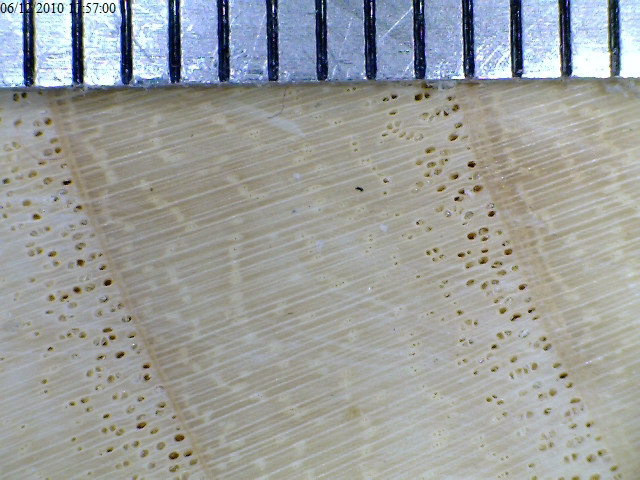
 Recycled pine at about 50 rings per inch


The picture above is taken with my USB microscope, the graduations are 1milimetre apart. We are looking at about 50 annual growth rings to the inch, so if this tree was 10 inch diameter then it would be around 250 years old. At its slowest there are 4 to 5 rings to the millimetre! In England we are lucky to get any softwood with more than 7 rings to the inch. This is because we have a long growing season, we do not get that cold and have reasonably good soils. In this part of the world softwoods are not for fine furniture or other crafts or artefacts; and to do a fine detailed carving from Western Red Cedar or Douglas fir is unheard of, we use them for chainsaw carving. In the states and Canada these woods are used extensively, and they have very different qualities to our wood as they are slow grown. I used to make Native American style flutes and would never use our native woods, it is just not possible, but in the Americas they are superb, their nice tight grain takes the detail very well.


Recycled pine fan bird, from the above wood

Rived feathers before they are fanned out, from ash. All feathers need to be the same thickness.


So, if there is anyone out there that can supply me or point me in the right direction of very slow grown softwoods, as near the Arctic circle or the Baltic regions or even from Canada, I would be a happy person. That is: tangential face planks that are straight-grained and knot free. Other names for the tangential face are flat-sawn, flat-grain, plain-sawn or even slash-sawn.

So in the first picture the darker rings are the latewood and are harder than the early wood growth which is the bit that varies in width depending on how good a growing season was. So the more growth rings to the inch, the higher proportion of late wood rings, and the stronger the wood is. The earlywood is soft and will absorb stain more readily, it also sands away quicker, so you can be left with an undulating surface with the latewood protruding.

In ring-porous hardwood, that is woods such as oak and ash which have large pores concentrated in the early wood and smaller pores in the latewood, the opposite is true. The wider the rings, the stronger the wood. So, do not make chair legs or handles from ash with 15 or more rings to the inch, they can easily be broken. At the APF this year we had for the competition, a load of ash; some of which was very slow grown, more than 15 rings per inch, and making fan birds out of this was easy. The wood was not hard but the more growth ring to the inch the more likely the feathers would snap off when bent. My ideal ash wood is 3 to 6 rings per inch for chair and handle making.

Fast grown English ash at about 3 rings per inch, the earlywood has the large pores


Slow grown English ash at about 20 rings per inch from the APF

I have not been able to find any relationship in diffuse porous woods between rings per inch and strength; that is, in woods that have pores more or less the same size throughout each growth ring. Can anyone enlighten me on this; how do you tell if you have a strong or weak plank of diffuse porous wood?